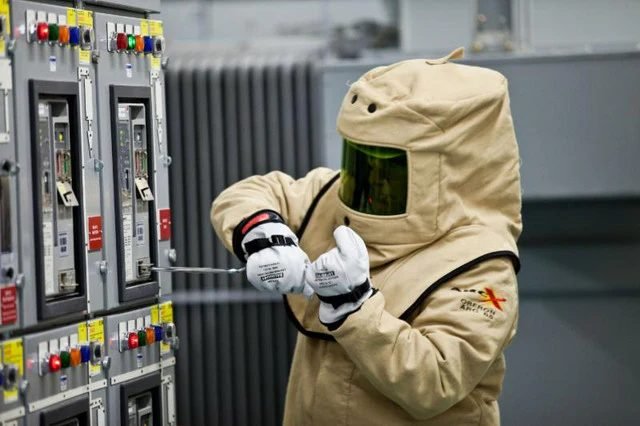
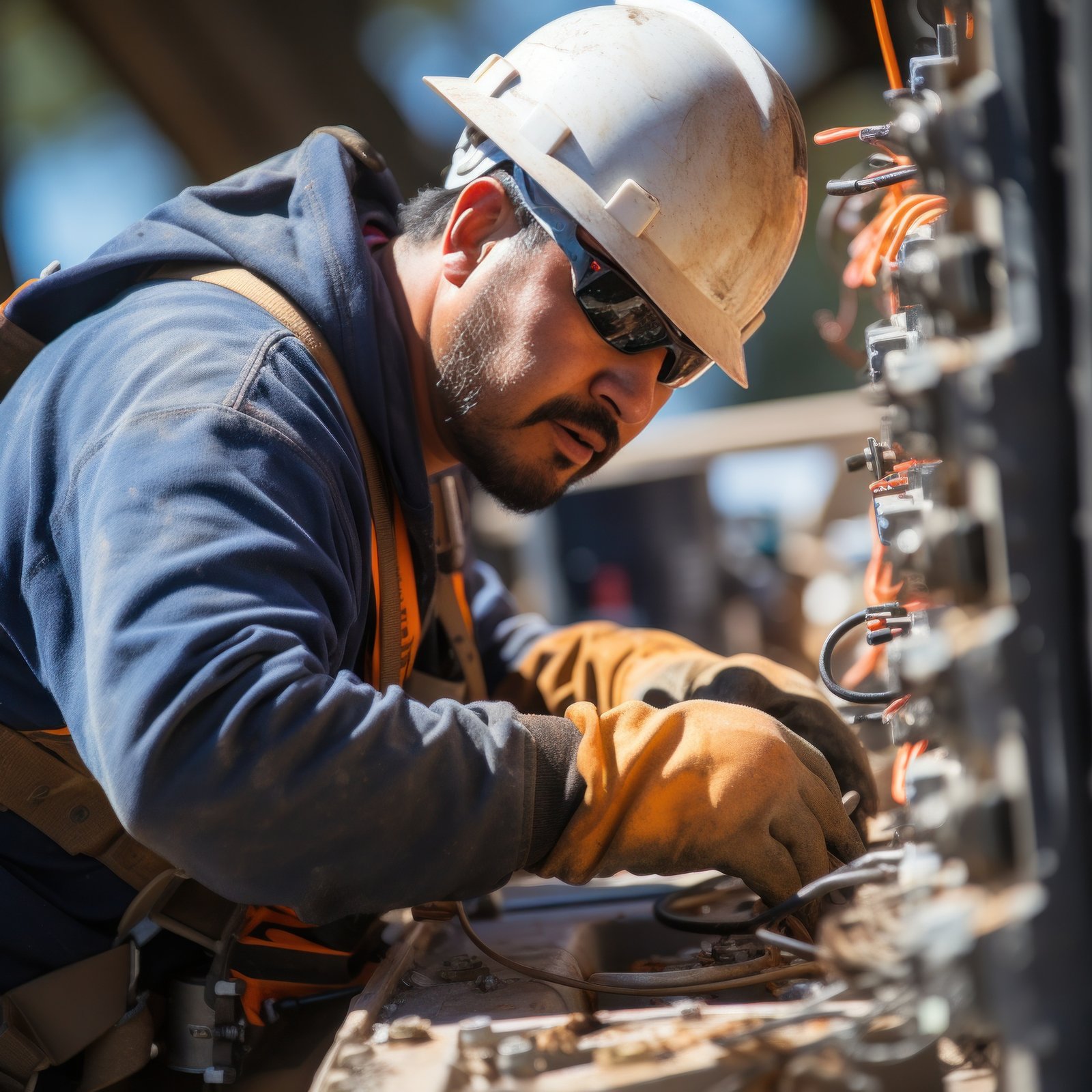
“Arc flash maintenance contractor” means two different things depending on which side of the contract you sit on — and both sides land in the same place. If you run a maintenance contracting firm, it means your technicians work on and around energized electrical equipment on someone else’s property, and they need to be trained, qualified, and documented to the current edition of NFPA 70E — the 2027 edition, in effect since May 6, 2026. If you run a facility and you are hiring a maintenance contractor, it means you need to know — before the first panel cover comes off — that the crew walking in the door meets that same bar. This page covers both: what a maintenance crew actually needs, and what a facility should verify.
If your firm is an electrical contractor — a crew of electricians proving qualification to clients and general contractors — the companion piece on NFPA 70E training for electrical contractors covers your paperwork in detail. This article is about the broader maintenance trades: the mechanical, HVAC/R, controls, and building-services crews whose work brushes electrical hazards constantly, and the firms that employ them.
Why maintenance contractors sit in the arc flash blind spot
An arc flash is a release of energy caused by an electric arc — an unintended fault current passing through air between conductors or to ground — producing intense heat, light, a pressure wave, and shrapnel. It does not check trade licenses first. According to the Electrical Safety Foundation International (ESFI), roughly 70% of workplace electrical fatalities happen to workers who are not electricians — laborers, HVAC mechanics, facilities generalists, and maintenance crews.
That statistic is the maintenance contractor’s problem in one line. Maintenance techs are the people who reset the tripped breaker at 2 a.m., open the panel to trace a control-power fault, change the ballast fed from a live lighting circuit, and troubleshoot the air handler whose disconnect may or may not actually kill everything in the cabinet. Most facility arc flash programs were written with the in-house electrician in mind. The contractor’s crew — on site two days a month, working from a truck, under time pressure — is exactly the population the program forgets, and exactly the population the fatality data points at.
What “qualified” means for a maintenance crew — and who needs it
Under NFPA 70E, a qualified person is one who has demonstrated skills and knowledge related to the construction and operation of the electrical equipment and installations, and has received safety training on the hazards involved. Two words in that definition do the heavy lifting for maintenance contractors: demonstrated and equipment. Qualification is established by training plus task-specific demonstration — it is not a blanket credential a technician carries from any piece of equipment to every other, and it is not something a certificate alone confers.
For a mixed maintenance crew, that produces a split most firms have never formalized:
- Techs who interact with energized electrical equipment — verifying a circuit is dead, opening panels, troubleshooting controls, operating disconnects under load — need qualified-person training to the current edition, and their employer needs to determine and document which equipment and tasks each person is qualified for.
- Techs who work near electrical hazards but never inside them — filter changes, belt swaps, general building maintenance around energized gear — need awareness-level training so they can recognize the hazard, know the boundaries, and know what they are not permitted to touch.
A firm that trains everyone to the awareness level and no one to the qualified level has a crew that legally cannot do half its work orders. A firm that assumes every tech is “qualified” because they have been doing this for twenty years has confused experience with qualification — and it is documentation, not tenure, that gets examined after an incident.
The training a maintenance contractor’s crew actually needs
The current standard is the 2027 edition of NFPA 70E, in effect since May 6, 2026. Training delivered to an older edition is training to a superseded standard, and the 2027 edition also makes the paperwork explicit: employers must both provide training and document it (§105.3(A)) — written records are a stated requirement, not an implied one.
In practice a maintenance contracting firm needs three things on the training side:
- Initial training to the 2027 edition for every tech whose work touches electrical hazards — qualified-level for those who work on or near energized equipment, awareness-level for the rest of the crew.
- Retraining at intervals not to exceed three years — and sooner when job tasks or equipment change, procedures change, an incident or near-miss occurs, or observed performance shows a deficiency. For a contractor, note what that trigger list means: new client sites with unfamiliar equipment are exactly the “tasks or equipment change” case. The three-year clock is a ceiling, not a schedule.
- Records that travel. Certificates with names, dates, and the edition trained to; retraining due dates; and a roster mapping each tech to what they are qualified for. This is the packet a client asks for before mobilization — and the packet an investigator asks for after an incident. They should be the same packet.
Because maintenance crews are scattered across sites by definition, the live virtual format solves the logistics problem that keeps contractor training perpetually “next quarter”: one instructor-led session, techs joining from wherever that day’s work order put them, individual certificates documented per worker. Onsite delivery works when you can gather the crew; virtual works when you cannot.
Get the whole crew certified without idling it
Live virtual NFPA 70E classes run every week — techs join from any site, and every completion is documented to the 2027 edition. Onsite delivery is available when you’d rather bring the instructor to the shop. Group registration covers mixed crews in one pass.
Get a Crew QuoteFor facilities: what to verify before the contractor touches the gear
If you are on the hiring side, the time to discover a maintenance contractor’s crew has no current electrical safety training is before the contract is signed, not after the incident report. Five things worth verifying:
- Training certificates — with dates and the edition. Current means the 2027 edition, and it means retraining dates inside the three-year window for every tech who will work on your equipment.
- The qualified-person roster, mapped to your scope. Not “our guys are all trained” — a list of which techs are qualified for which tasks and equipment types in the scope of work. Qualification is task- and equipment-specific; the roster should read that way.
- Their written electrical safety program — and whose program governs. Settle in writing whether contractor work on your equipment follows their procedures, yours, or a defined combination, and how hazard information passes between you before work starts.
- Staffing for energized work. Under the 2027 edition, when an energized electrical work permit specifies shock or arc flash PPE, at least one additional person with emergency-response training is required — positioned outside the boundaries as standby rescue, not as a second set of hands on the task. A contractor who quotes solo coverage for permit-level energized work is quoting a staffing model the current edition does not allow.
- Your side of the handshake: current labels. The contractor’s crew selects protection from your equipment labels, and a label is a snapshot valid only for the system as studied. NFPA 70E expects the underlying incident-energy analysis to be reviewed at intervals not to exceed five years — and whenever the electrical system changes. Handing a qualified crew stale labels defeats their training.
Where OSHA fits
OSHA does not adopt NFPA 70E by name. It enforces electrical safety through Subpart S and the General Duty Clause, and uses NFPA 70E as the recognized industry standard — the measure of what a reasonable employer would have done, and the feasible means of abatement. That framing cuts both directions on a maintenance contract: the contracting firm is the employer of its techs and owns their training and qualification, and the host facility has its own duties to the contract workers on its site. After an incident, both sets of decisions get measured against the same standard — which is the practical reason both sides should be able to produce their paperwork on request.
Frequently asked questions
Do maintenance technicians really need NFPA 70E training if they aren’t electricians?
If their work puts them on or near energized electrical equipment — opening panels, resetting breakers, troubleshooting controls — yes. ESFI’s data attributes roughly 70% of workplace electrical fatalities to workers who are not electricians, and maintenance trades are squarely in that population.
Does every tech on a maintenance crew need to be a “qualified person”?
No — and pretending they all are is its own problem. Techs who work on or near energized equipment need qualified-person training with task-specific demonstration; techs who only work in the vicinity need awareness-level training. The firm should be able to say which tech is which, in writing.
How often does a maintenance crew need retraining?
At intervals not to exceed three years — and sooner when tasks or equipment change, procedures change, an incident or near-miss occurs, or observed performance shows a deficiency.
We’re a facility hiring a maintenance contractor. What proof should we ask for?
Training certificates showing the 2027 edition with dates inside the three-year window, a qualified-person roster mapped to your scope of work, and their written electrical safety program — plus a written agreement on whose procedures govern work on your equipment.
Can a scattered crew get trained without pulling everyone off their sites?
Yes — that is what the live weekly virtual sessions are for. Techs join from any location, the class is live and instructor-led, and each completion is individually documented. Onsite sessions are available when the crew can gather.