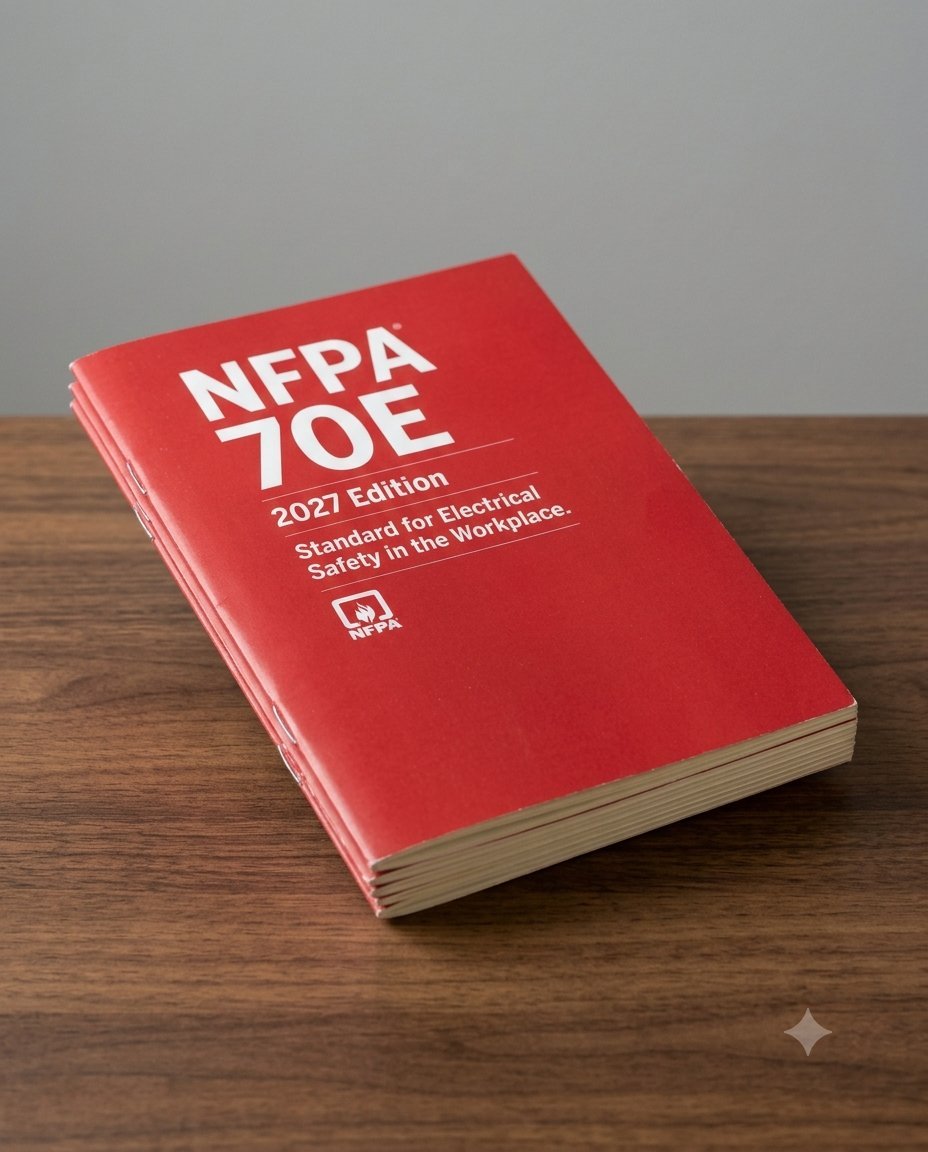
NFPA 70E compliance consulting is an outside review of the four things the standard puts on a clock — your written electrical safety program, your workers' training currency, your arc flash risk assessment, and the labels on your equipment — plus a check of whether anything has changed on your distribution system since those were last done. You need it when nobody inside the building owns those clocks, or when something changed and nobody re-ran the numbers. You do not need it as a standing subscription. Most facilities need a real review once, a correction pass, and then an internal process that keeps it current.
This page describes what a competent review actually covers, so you can tell the difference between a genuine compliance assessment and a sales visit with a checklist.
What a compliance review actually covers
NFPA 70E, Standard for Electrical Safety in the Workplace, has been in its 2027 edition since May 6, 2026. A review done against the 2024 text is a review of a superseded document. The work itself divides into four areas, and a review that skips any of them is not a compliance review:
- The written electrical safety program. Does it exist, does it describe how your facility actually works, and has it been reviewed inside the required interval?
- Training and qualification. Who is a qualified person for which equipment, how was that established, and when does each person's training expire?
- The arc flash risk assessment. When was the incident energy analysis last run, and against what system configuration?
- Equipment labelling. Do the labels match the current study, and does anyone check?
The four clocks — and which one everybody misses
Three of these are calendar clocks and are easy to audit. The fourth is not a clock at all, and it is where most programs quietly fail.
The electrical safety program is reviewed at intervals not to exceed three years. That is a document review: does what is written still describe what people do?
Retraining is required at intervals not to exceed three years — and sooner when procedures change, when job tasks or equipment change, when an incident or near-miss occurs, or when observed performance shows a deficiency. A new edition of the standard is exactly the kind of change that triggers the "sooner" clause.
The incident energy analysis is reviewed for accuracy at intervals not to exceed five years, and the data on the label is reviewed on the same five-year cycle, with the label updated where that review finds it inaccurate.
That gap is the single most valuable thing an outside review finds, because it is invisible to a calendar-based audit. It is also the reason a compliance review should always start with "what have you changed in the last five years?" rather than "when was your last study?"
Who carries the responsibility
The equipment owner is responsible for the documentation, installation and maintenance of the field-marked label. Not the contractor who installed the gear, not the engineering firm that ran the study, and not the training vendor. If a consultant's proposal reads as though hiring them transfers that responsibility, it does not, and a consultant worth using will tell you so on the first call.
What OSHA does with any of this
This is the question that gets asked in every class, and the honest answer is more useful than the scary one. OSHA does not adopt NFPA 70E by name in Subpart S. It enforces electrical safety through Subpart S and the General Duty Clause, and it uses NFPA 70E as the recognized industry standard — the measure of what a reasonable employer would have done, and the feasible means of abatement.
In practice that means nobody cites you for "violating NFPA 70E." They cite you under the General Duty Clause, and NFPA 70E is the document used to establish what you should have been doing. That is a weaker hook than a directly incorporated standard and a much harder one to argue with after an incident, because the standard is where your own industry has written down what reasonable looks like.
When outside help is worth it — and when it is not
Bring someone in when: you have inherited a facility and cannot establish when the study was last run; you have made changes to protective devices or settings and are unsure whether the labels still hold; you have grown past the point where one person can remember who is qualified for what; or you have had an incident or near-miss and need an independent read rather than an internal one.
Do not bring someone in to write a program you will not maintain. A binder produced by a consultant and never opened again is worse than no binder, because it establishes that you knew what was required. The deliverable that actually helps is a short, specific list of what is out of date, what changed, and who inside your organisation now owns each clock.
Five questions to ask before you sign
- Which edition are you reviewing against? If the answer is not 2027, stop.
- Will you ask what has changed on our distribution system, or only when the last study was dated? The second answer alone means they will miss the event-driven trigger.
- What do we get that we can act on? A findings list with owners and dates beats a bound report.
- Who does the training, and are they the same people who wrote the findings? They should be able to teach it, not just document it.
- What do you expect us to be able to do ourselves in twelve months? A consultant who wants to be permanently necessary is selling something other than compliance.
Where training fits
Most of what a compliance review turns up is a training problem wearing a documentation costume. A qualified person is someone who has demonstrated skills and knowledge related to the construction and operation of the electrical equipment and installations, and who has received safety training on the hazards involved. That is established by training plus task-specific demonstration — it is not a card, and it is not permanent. If your review finds that nobody can say who is qualified for which equipment, the fix is a class and a record, not a policy rewrite.
What to have ready before the review starts
Most of the cost and most of the wasted time in a compliance engagement comes from hunting for documents that nobody owns. Pull these together first and a two-day review becomes a one-day review:
- The written electrical safety program, with the date of its last review — not the date it was written.
- The incident energy analysis, including the one-line diagram it was built from and the date of the study. If you have the study but not the one-line it used, say so; that is itself a finding.
- A list of every change to the distribution system since that study — new or replaced breakers, protective device setting changes, transformer replacements, added load, service changes. Maintenance work orders are usually a better source for this than engineering records.
- Training records by person and by equipment, with dates, not just a roster of who attended something.
- Photographs of a representative sample of equipment labels, including at least one panel you suspect is out of date. The suspect one is the useful one.
The third item is the one that takes real effort and the one that determines whether the review finds anything. A facility that can produce a clean change log usually discovers its labels are fine. A facility that cannot produce one has already answered the most important question.
Frequently asked questions
Is NFPA 70E compliance consulting required?
No. Nothing in the standard requires an outside consultant. The standard requires the program, the training, the assessment and the labels to exist and to be current — how you get there is your choice.
How often should a compliance review happen?
There is no required review interval for a consulting engagement. The intervals that do exist belong to the underlying items: three years for the electrical safety program and for retraining, five years for the incident energy analysis and label data review, plus an update whenever a distribution system change could affect the analysis.
Does a compliance review replace an arc flash study?
No. A review tells you whether your study is current and whether the labels match it. Producing or updating the incident energy analysis itself is separate engineering work.
We had a study done four years ago and nothing has changed. Are we fine?
Probably, on the calendar. The question to answer first is whether "nothing has changed" is verified or assumed — breaker setting changes and protective device swaps are routine maintenance actions that rarely get reported to whoever owns the study.
Can our own people do this?
Yes, and that should be the goal. The work is knowing which clocks exist, checking them, and having a route by which an engineering change reaches whoever owns the arc flash study. Outside help is most useful for establishing the baseline and training the people who will keep it.